- Swim Teach Home
- Swimming Lesson Plans
- stage 2
Stage 2 Swimming Lesson Plans: What to Teach and a Free Sample Plan
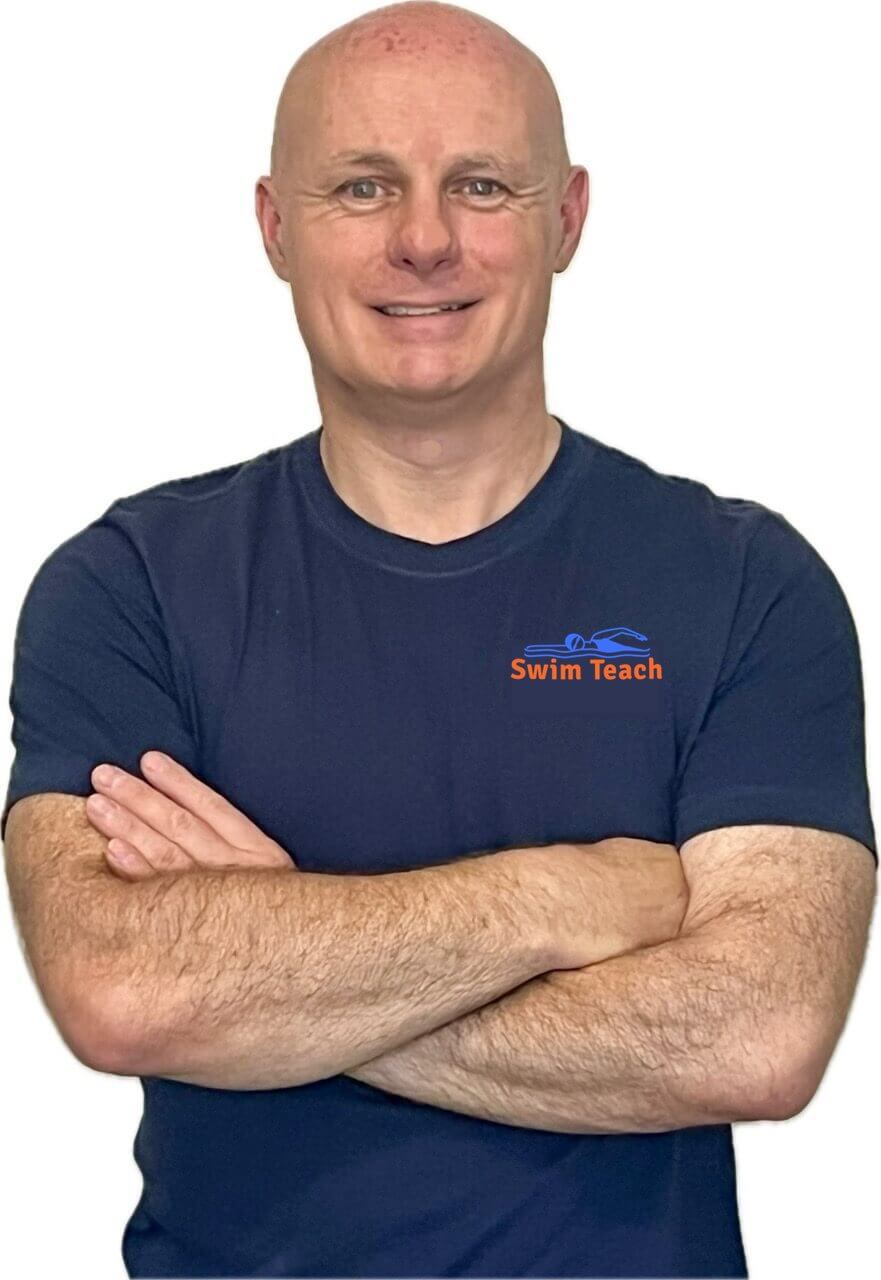
By Mark Young
Stage 2 is where swimmers start doing things on their own. They jump in, glide and kick a short distance without floats, and learn to roll from front to back and stand up again. It's a big step, and it's very common for swimmers to wobble between Stage 1 and Stage 2 for a while.
Below you'll find what Stage 2 covers, an eight-lesson sequence that takes a group through it, a complete sample lesson plan, and how to teach the skills that catch teachers out.
These are my own lesson plans, written over 30 years of teaching. They follow the Stage 2 outcomes of the Swim England Learn to Swim programme, but the skills are the same next steps every beginner needs, wherever you teach. Check the current outcomes with your own swim school or governing body.
What Stage 2 covers
Stage 2 builds independence. Swimmers learn to:
- Jump in from the poolside safely
- Blow bubbles in a steady rhythm with the nose and mouth under
- Float on the front and back and stand up again without support
- Push and glide on the front and back from the wall
- Kick 5 metres on the front and on the back without floats, feet off the floor
- Roll from a front float to a back float (and back again) with a tuck, then stand
- Log roll from front to back and back to front
- Get out of the water without help
The big difference from Stage 1 is that swimmers do all of this without floats or support. For the exact wording of the outcomes, check your own programme.
Free Stage 2 lesson plan and checklist
The sample lesson below as a printable PDF, plus an eight-lesson sequence and a checklist of every Stage 2 skill.
I'll only use your email to send what you ask for. Privacy policy.
An eight-lesson sequence for Stage 2
Treat this as a guide, not a timetable. Some swimmers will need several lessons on kicking without floats, and that's completely normal. The plan numbers refer to my 101 Swimming Lesson Plans book.
| Lesson | Focus | Stage 2 skills it covers | Plan |
|---|---|---|---|
| 1 | Breathing and submerging | Rhythmic bubbles with the face in | #4 |
| 2 | Independence and standing up | Standing up unaided, jumping in | #5 |
| 3 | Front paddle basics | Kicking on the front, gliding | #7 |
| 4 | Independent front paddle | Unaided glide, jump in, kick 5 m on the front | #9 |
| 5 | Back paddle basics | Kicking on the back, back glide | #10 |
| 6 | Independent back paddle | Kick 5 m on the back without floats | #11 |
| 7 | Shallow water skills | Rotating front to back, standing up | #13 |
| 8 | Recap and assessment | Log rolls, tuck rotations, exit unaided, all skills checked | Mix |
Sample Stage 2 lesson plan: independent front paddle
This is lesson 4 in the sequence. It covers three Stage 2 skills in one lesson (jumping in, gliding without floats and kicking on the front) and it's the lesson where many swimmers first realise they can move through the water on their own.
Level: child beginner · Previous learning: basic front kicking and pulling · Equipment: buoyancy aids, floats, woggles, a floating hoop
| Activity | Teaching point | Organisation | Time |
|---|---|---|---|
| Entry: swivel entry or the pool steps | take your time | all together | 1 min |
| Warm up: 2 widths with buoyancy aids | kick and pull | all together | 2 mins |
| Main theme: push and glide with no floats | face in the water | one by one | 3 mins |
| Kicking, holding a float out in front | pointed toes | waves | 3 mins |
| Kicking with a float under one arm, adding arm pulls | fingers together | waves | 3 mins |
| Kicking and pulling with a woggle, face in the water | scoop for ice cream | waves | 3 mins |
| Push and glide, adding arm pulls and leg kicks | chin down, toes up | waves | 3 mins |
| Push and glide, adding arm pulls and leg kicks, face in the water | deep breath and kick fast | waves | 3 mins |
| Contrasting activity: standing jump from the poolside, swim through a floating hoop | jump away from the side | one by one | 3 mins |
| Star float on the back | stretch out, chest up | waves | 3 mins |
| Exit: the pool steps | take your time | one by one | 1 min |
| Total | 28 mins | ||
If a swimmer can't yet reach the wall without floats, shorten the distance rather than the challenge. Move them closer. Success over 2 metres builds the confidence for 5.

Need Fresh Lesson Ideas For Your Swimming Classes?
Here are 101 ready-made swimming lesson plans designed to help you walk onto the poolside with a clearer plan, more confidence, and less last-minute preparation.
- 101 complete lesson plans ready to use
- Covers different swimmer levels and abilities
- Instant PDF download for mobile, tablet, or desktop
Teaching the Stage 2 skills that catch teachers out
Kicking without floats. Take the floats away gradually, not all at once: two floats, then one, then a float held out in front, then a push and glide with a few kicks. A swimmer who has kicked 2 metres on their own will happily try 5.
Rhythmic bubbles. It's not one big breath and a dunk. I count out loud: "breathe in, face in, blow, up", three times in a row, slowly. Swimmers who rush it usually haven't fully exhaled, so the next breath feels like a gasp.
The tuck rotation. From a front float, hug the knees to the chest, let the body roll gently onto the back, then stretch out into a back float before standing. "Tuck like a ball, then open like a starfish" works well with younger swimmers. Do it slowly. Speed makes them panic.
The log roll. The opposite of the tuck: the body stays long and straight, and the shoulders and hips turn together. "Roll like a log", or "turn like a rolling pin", helps. If the hips get left behind, ask them to lead with the shoulder and the hips will follow.
Getting out unaided. Teach a safe technique, not just "climb out": both hands on the side, push up, one knee onto the edge, then stand. Practise it at the end of every lesson so it becomes routine.
Assessing Stage 2
Watch each swimmer against every skill over a couple of lessons, not just once. At this stage the floats are gone, so a swimmer who manages 5 metres on a good day may not on a tired one. Only count a skill as achieved when they can do it confidently most of the time.
The free checklist above lists every Stage 2 skill in one place, ready to print and use on poolside.
Using a different programme?
Other programmes use their own names for a similar level. As a rough guide only, the STA's conversion chart puts Swim England Stage 2 alongside STA Octopus 2 (International Learn to Swim) or Grade 2. Equivalents for other programmes vary, so check your own programme's chart.
If your programme isn't listed, the skills in the checklist are still a good guide to what a beginner needs after the very first steps.
Common questions
How long does Stage 2 take?
It varies a lot. Kicking without floats is the big hurdle, and some swimmers take a term or two to feel safe doing it. Move on when they're confident, not when the calendar says so.
Can swimmers use floats in Stage 2?
To learn the skills, yes. To achieve them, no. Use floats as stepping stones and take them away gradually.
What's the difference between Stage 1 and Stage 2?
Stage 1 is about confidence with support. Stage 2 is about doing the same kinds of skills on your own: gliding, kicking and standing up without floats, plus jumping in and rolling over.
What comes after Stage 2?
Swimmers start to learn proper strokes over longer distances. If some of your group aren't ready, go back to the Stage 1 skills for a few lessons.
For your next Stage 2 lesson
For now, focus on one thing: take one float away from every swimmer who's nearly ready, and shorten the distance so they succeed. A few metres on their own today is worth more than 5 metres with a float.
Stage 2 is where swimmers first feel they can really swim. Give them lots of small wins, and they'll get there.

 |
Thanks for checking out my website and all the information here about learning to swim and teaching swimming. I really hope you have found some inspiration and support. If you're as passionate about teaching swimming and learning to swim as I am, feel free to follow me on any of these channels: Cheers!  |
Thanks for checking out my website and all the information here about learning to swim and teaching swimming. I really hope you have found some inspiration and support.
If you're as passionate about teaching swimming and learning to swim as I am, feel free to follow me on any of these channels:
Cheers!
All Rights Reserved