- Swim Teach Home
- teaching butterfly
How to Teach Butterfly Stroke to Beginners
By Mark Young
Butterfly is the stroke many teachers quietly dread. Swimmers want to try it because it looks impressive. Then they throw themselves at it, swallow half the pool and give up after five metres.
That’s normal, and it’s rarely a strength problem. Most swimmers struggle with butterfly because the rhythm is wrong, not because they aren’t strong enough. Get a smooth body wave and two kicks to every arm pull, and butterfly becomes far less tiring than it looks.
The short version: make sure they’re ready, teach the body wave and the dolphin kick before anything else, add the arms, then the breathing, and keep every practice short. Below is how I teach each part, the drills I use, what I say on poolside, and how to fix the faults you’ll see most.
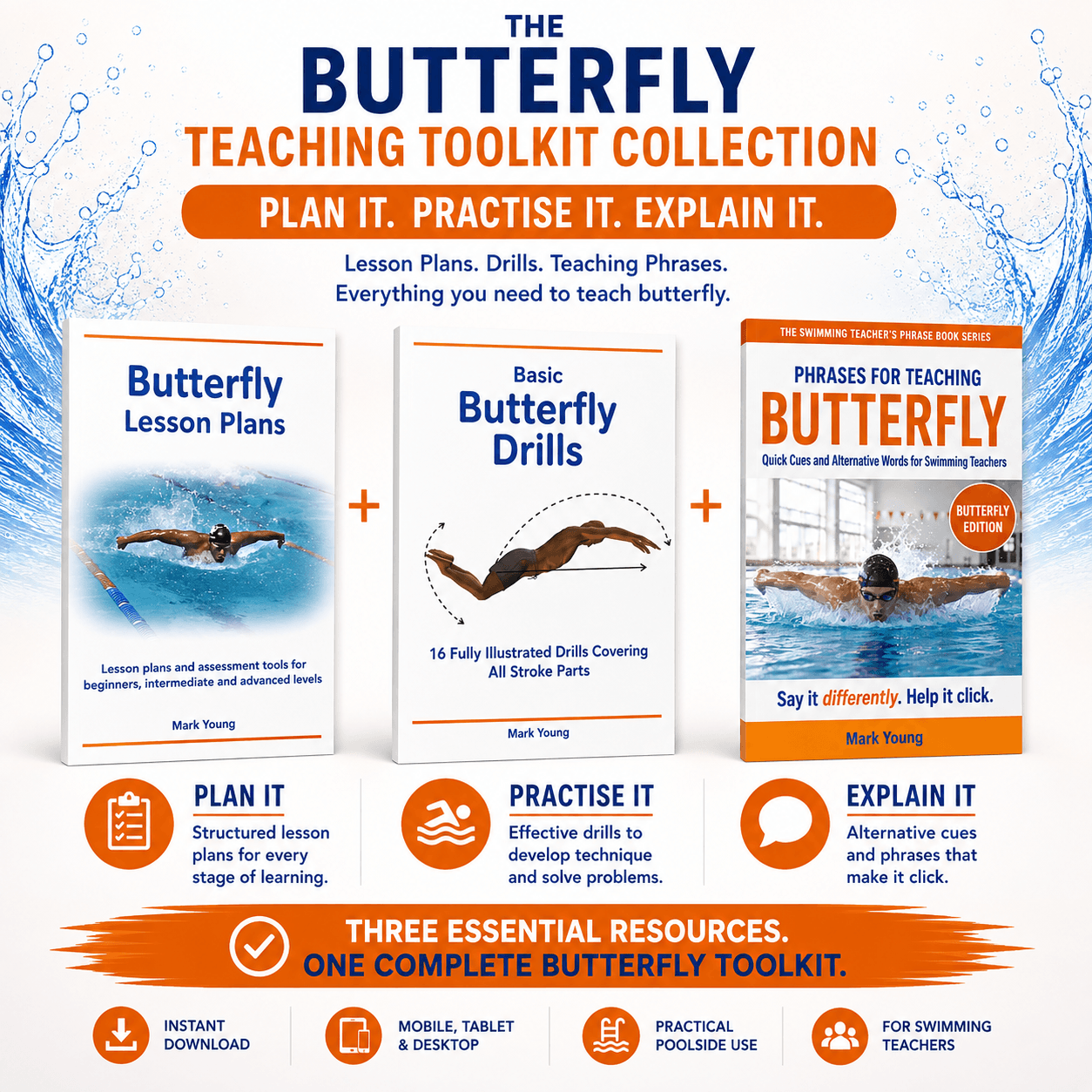
Plan it, practise it, explain it: the Butterfly Teaching Toolkit
Everything on this page, done for you. The toolkit gives you 18 ready-made backstroke lesson plans, 16 drills covering every part of the stroke, and my Phrases for Teaching Butterfly, so you always have another way to explain it when a swimmer gets stuck.
Is your swimmer ready for butterfly?
Butterfly is not a first stroke. Before I start it with anyone, I want to see that they can:
- swim front crawl comfortably for a few widths;
- breathe out underwater in a relaxed, controlled way;
- push and glide in a streamlined position on the front;
- manage short bursts of effort without panicking.
There’s no set age. Some young swimmers pick up the dolphin kick very quickly, while some adults find it awkward for weeks. If they’re not ready, they’ll only learn to struggle, and that’s very hard to unlearn.
What good butterfly looks like


Body position: a gentle wave from head to toe, led by the head, with the hips rising and falling. The wave should be small. The flatter, the better.
Legs: a dolphin kick, with both legs together, kicking from the hips and speeding up on the way down.
Arms: both arms together. The hands go in thumbs first, in line with the shoulders, pull under the body in a keyhole shape and push past the thighs, then swing low over the water.
Breathing: a quick breath, with the chin pushed forward rather than up, as the arms finish pulling. The face goes back in before the arms land.
Timing: two kicks to every arm pull, one as the hands go in and one as they push past the thighs.
The biggest thing to keep in mind is rhythm. A smooth wave beats a big splash every time.
Where to start
With butterfly, I always start with the body wave and the kick, because the arms and breathing only work once the body is moving properly. A good order for most beginners is:
- The body wave, standing and then in the water.
- The dolphin kick, holding the side, then with a push and glide.
- The arms, standing and walking through the water, then in a push and glide.
- Breathing, added to the arms.
- Timing, slowly, two kicks to each pull.
Once a swimmer can manage a few strokes, stop working through the list in order. Watch what’s holding them back most and work on that.
Teaching the body wave
This is the heart of the stroke. The movement starts at the head and travels down through the chest, hips and legs. The fault you’ll see most is too much of it: big up-and-down bobbing that uses lots of energy and goes nowhere.
Drills I use:
Standing on the poolside, showing the hip movement. It gets a laugh, and it helps.
Floating face down, a slow dolphin action.
Dolphin dives while walking through the water. Great fun for children, and they learn the wave without thinking about it.
Push and glide with arms by the sides, adding the wave, then adding dolphin kicks.
What I say:
“Pretend you’re a belly dancer.”
“Lead with the top of your head.”
“Make your body into a long wave.”
“Move like a dolphin.”
Teaching the dolphin kick
Both legs kick together, from the hips, and the power comes on the way down. Two faults come up again and again: bending the knees too much, so it becomes a bicycle kick, and the legs drifting apart. Some swimmers also slip into a breaststroke kick without realising.
Drills I use:
- Sitting on the poolside, legs in the water, kicking both legs together.
- Dolphin kick holding a float, if needed.
- Push and glide, adding dolphin kicks.
- Dolphin kick on the back. It’s much easier to see whether the kick is coming from the hips.
- 2 widths dolphin kick, arms by the sides.
What I say:
“Legs together, kick from your hips.”
“Show me your dolphin tail.”
“Kick like a mermaid.”
“Speed up on the way down.”
Teaching the butterfly arms
Both arms work at the same time, all the way through. The pull goes under the body in a keyhole shape and finishes by pushing past the thighs. Swimmers who stop the pull short find the recovery heavy and quickly run out of steam.
Drills I use:
- Standing on the poolside, going through the arm movement slowly, one stage at a time.
- Walking through the water, with the basic arm movement.
- Push and glide adding arm pulls, then adding arms and legs together.
- Dolphin kick on the back, adding double arms.
What I say:
“Both arms at the same time.”
“Thumbs go in first.”
“Draw a keyhole under your body.”
“Push past your thighs.”
Teaching butterfly breathing
The breath comes as the arms finish pulling and the body rises naturally. The faults are lifting the head too high, which drops the hips, and breathing too late, so the face is still up when the arms land.
Start standing on the poolside with the arm action and breathing, then walking through the water. Next, add breathing to dolphin kicks, breathing every four kicks, and finally to the full stroke. Beginners can breathe every stroke. Breathing every other stroke helps keep the body flatter once they’re ready.
What I say:
“Chin forward, not up.”
“Breathe in as your arms come out.”
“Quick breath, face straight back in.”
“Blow out into the water.”
Putting it together: the timing
Butterfly has two kicks to every arm pull. The first kick comes as the hands go in, and lifts the hips that dropped while the arms were out of the water. The second comes as the hands push past the thighs, and adds power just when the arms speed up. Most beginners lose the second kick first.
Drills I use:
- Push and glide adding leg kicks, counting two kicks at a time.
- Push and glide adding arm pulls, keeping the arms continuous.
- Push and glide adding legs and arms together, slowly at first.
- 1 width full stroke, then 2 widths.
What I say:
“Kick your hands in, kick your hands out.”
“Kick, pull, kick, recover.”
“Two kicks to every pull.”
Keep the distances short. Two good widths are worth far more than a length of struggling, because a tired swimmer only practises bad habits.
If one of these cues doesn’t land, say it differently, not louder. That’s why the Butterfly Teaching Toolkit includes a whole book of alternative butterfly cues, and why the butterfly card on my free poolside cue cards has a picture cue for every part.
Common butterfly faults and how to fix them
Too much wave. Lots of bobbing, not much going forward. Ask for “a small wave” and go back to dolphin kicks with the arms by the sides.
Bicycle legs. The knees bend too much and the kick comes from the knees. Dolphin kick on the back shows it straight away.
A breaststroke kick. The feet turn out and the legs separate. Holding the poolside, slow dolphin kicks, with “legs together, kick from your hips”.
Arms dragging through the water. Usually the pull stops short. “Push past your thighs” helps the arms clear the water, and so does a stronger second kick.
Head too high to breathe. The hips sink and the next stroke is twice as hard. “Chin forward, not up.”
Missing the second kick. The stroke stalls after the arm pull. Slow full stroke counting out loud: “kick your hands in, kick your hands out”.
Tiring after a few strokes. That’s usually rhythm, not fitness. Shorten the distance and slow the stroke down.
A sample butterfly lesson plan
Here’s a 28-minute lesson I use for a first go at full stroke butterfly, with adult or child beginners who already swim a basic front crawl.
| Activity | Teaching point | Organisation | Time |
|---|---|---|---|
| Entry: swivel or steps entry | enter slowly | all together | 1 min |
| Warm up: 2 widths any stroke, with buoyancy aids if needed | take your time | all together | 3 mins |
| Main theme: standing on the poolside showing the hip movement | pretend you're a belly dancer | all together | 2 mins |
| Push and glide adding leg kicks, with a woggle if needed | legs together | waves | 3 mins |
| Push and glide adding arm pulls | arms go in together | waves | 3 mins |
| Push and glide with arms, legs and breathing, woggle if needed | blow out into the water | waves | 3 mins |
| Push and glide adding arm pulls and leg kicks | 2 kicks to one arm pull | waves | 3 mins |
| 2 widths full stroke butterfly | kick and pull continuously | waves | 3 mins |
| Contrasting activity: star float on the front | deep breath and relax | 2 or 3 at a time | 3 mins |
| Sitting dive through a hoop at the surface | head tucked down | 2 or 3 at a time | 3 mins |
| Exit: pool steps or over the poolside | take your time | one by one | 1 min |
| Total | 28 mins |
If you want a full set of butterfly lessons, with the drills and the words to go with them, they’re all in my Butterfly Teaching Toolkit.
Common questions
When is a swimmer ready to learn butterfly?
When they can swim front crawl comfortably, breathe out under water and push and glide in a streamlined shape. Starting earlier usually means learning to struggle.
What age should children learn butterfly?
There’s no set age. It depends on coordination and confidence more than birthdays. Many children enjoy the dolphin kick long before they’re ready for the full stroke, so let them play with it.
One kick or two?
Two kicks to every arm pull. Beginners often drop the second kick, so it’s worth checking for it.
Should beginners breathe every stroke?
Every stroke is fine to start with. Breathing every other stroke helps keep the body flatter once they’re ready for it.
Why do my swimmers get so tired swimming butterfly?
Usually it’s too much wave or a missing second kick, not a lack of strength. Shorten the distance, slow the stroke down and work on the rhythm.
For your next butterfly lesson
For now, focus on the wave. Ask your swimmers to push and glide with their arms by their sides and add a small dolphin movement, led by the head. Watch who bobs and who glides. The smoothest wave in the group is the one to show the others.
Butterfly takes patience. Keep the practices short, praise rhythm over effort, and you’ll be surprised how quickly it starts to flow.
If you’re teaching all four strokes, here’s how I teach front crawl, breaststroke and backstroke.

 |
Thanks for checking out my website and all the information here about learning to swim and teaching swimming. I really hope you have found some inspiration and support. If you're as passionate about teaching swimming and learning to swim as I am, feel free to follow me on any of these channels: Cheers!  |
Thanks for checking out my website and all the information here about learning to swim and teaching swimming. I really hope you have found some inspiration and support.
If you're as passionate about teaching swimming and learning to swim as I am, feel free to follow me on any of these channels:
Cheers!
All Rights Reserved