- Swim Teach Home
- Swimming Lesson Plans
- Stage 1
Stage 1 Swimming Lesson Plans: What to Teach and a Free Sample Plan
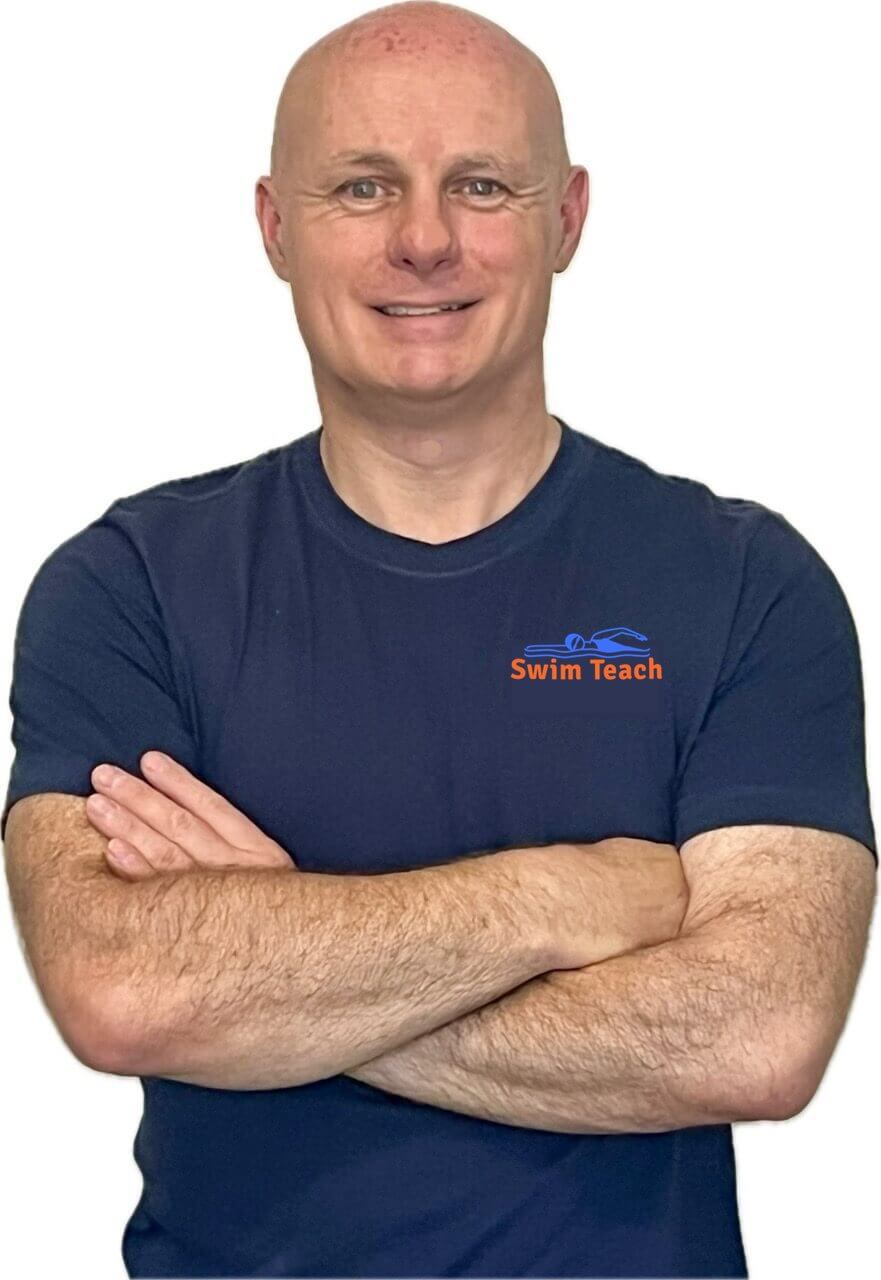
By Mark Young
If you've just been handed a Stage 1 group and you're wondering where to start, you're in the right place. Stage 1 is all about getting swimmers safe, happy and comfortable in the water. Nobody is expected to swim yet, and that's exactly how it should be.
Below you'll find what Stage 1 covers in plain English, a sequence of six lessons that takes a group through it, a complete sample lesson plan you can use straight away, and how to teach the outcomes that catch teachers out.
These are my own lesson plans, written over 30 years of teaching. They follow the Stage 1 outcomes of the Swim England Learn to Swim programme, but the skills are the same first steps every beginner needs, wherever you teach. Check the current outcomes with your own swim school or governing body.
What Stage 1 covers
Stage 1 is where swimmers build basic water confidence, learn to move safely in the water and start to understand pool safety. In my own words, a swimmer working towards Stage 1 learns to:
- Get into and out of the water safely
- Move forwards, backwards and sideways through shallow water, with feet on or off the floor
- Be happy with water on the face and water poured over the head
- Float on the front and on the back, and stand up again from both
- Push and glide on the front and on the back from the wall
- Name a couple of pool rules
Swimmers can use buoyancy aids and support at this stage. The aim is confidence, not independence. For the exact wording of the outcomes, check the Swim England Learn to Swim framework.
Free Stage 1 lesson plan and assessment checklist
Download the sample lesson below as a printable PDF, plus a one-page checklist of every Stage 1 outcome, so you can tick off each swimmer's progress on poolside.
I'll only use your email to send what you ask for. Privacy policy.
A six-lesson sequence for Stage 1
Every group is different, so treat this as a guide, not a timetable. Some groups will need two or three lessons on the early steps, and that's completely normal. The plan numbers refer to my 101 Swimming Lesson Plans book.
| Lesson | Focus | Stage 1 outcomes it covers | Plan |
|---|---|---|---|
| 1 | Entering and getting used to the water | Safe entry and exit, moving forwards and backwards | #1 |
| 2 | Getting used to the water | Moving around, water on the face | #2 |
| 3 | Confidence building | Water on the face and over the head | #3 |
| 4 | Independence and regaining standing | Floating and standing up again | #5 |
| 5 | Floating and gliding | Floats and glides on the front and back, standing up | #6 |
| 6 | Recap and assessment | Moving sideways, pool rules, all outcomes checked | Mix of the above |
Sample Stage 1 lesson plan: floating and gliding
This is lesson 5 in the sequence, and it's a good one to start with if you only take one thing from this page, because it covers three Stage 1 outcomes in a single lesson: floating on the front and back, gliding on the front and back, and standing up again.
Level: child beginner · Previous learning: face in the water and standing up again · Equipment: buoyancy aids and sinkers
| Activity | Teaching point | Organisation | Time |
|---|---|---|---|
| Entry: swivel entry or the pool steps | take your time | all together | 1 min |
| Warm up: 2 widths with buoyancy aids (assisted if necessary) | splash your feet | all together | 2 mins |
| Main theme: push and glide towards the side and stand up, with buoyancy aids as needed | legs together | one by one | 3 mins |
| Push and glide away from the side and stand up, with buoyancy aids as needed | stretch your arms in front | one by one | 3 mins |
| Star float on the back, with buoyancy aids as needed | tummy up | waves | 3 mins |
| Star float on the front, with buoyancy aids as needed | face in the water | waves | 4 mins |
| Push and glide on the back, away from the side | look up at the sky | waves | 3 mins |
| Mushroom float and stand up | chin on chest | waves | 3 mins |
| Contrasting activity: pencil jump, with buoyancy aids if needed | arms by your sides | waves | 3 mins |
| Submerge to collect a toy or sinker | deep breath and stretch down | one by one | 3 mins |
| Exit: the pool steps | take your time | one by one | 1 min |
| Total | 29 mins | ||
"Waves" means small groups taking turns, so you can watch each swimmer properly. If a swimmer isn't ready to put their face in for the front float, let them float with their chin on the water for now. Getting them relaxed matters more than getting it perfect.

Need Fresh Lesson Ideas For Your Swimming Classes?
Here are 101 ready-made swimming lesson plans designed to help you walk onto the poolside with a clearer plan, more confidence, and less last-minute preparation.
- 101 complete lesson plans ready to use
- Covers different swimmer levels and abilities
- Instant PDF download for mobile, tablet, or desktop
Teaching the Stage 1 outcomes that catch teachers out
Moving sideways. It's easy to forget, because none of the strokes go sideways. I turn it into a game: "walk like a crab along the wall", or side-step to collect toys floating along the edge of the pool. Holding the wall at first is fine.
Standing up again from a float. Teach this before you ask for a float, not after. From the front: knees to the chest, push both arms down, lift the head, feet down. From the back: chin to the chest, sit as if in a chair, feet down. Until a swimmer knows they can get their feet back down, they won't relax enough to float.
Water over the head. Some children find this the hardest outcome of all. Use a watering can or a cup, let them pour it themselves first, and ask them to look up so the water runs back over the hair rather than into the eyes.
Pool rules. Swimmers need to be able to tell you a couple of rules, not just follow them. I ask one swimmer at the end of each lesson to tell the group a rule (walk on poolside, get in feet first, listen to the teacher, no pushing) so by the end of the stage everyone has heard them a dozen times.
Assessing Stage 1
Watch each swimmer against every outcome over a couple of lessons, not just once. A swimmer who floats beautifully on Tuesday may freeze on Thursday, and that's normal at this stage. I mark each skill as below average, average or above average, and only count it as achieved when a swimmer can do it confidently most of the time.
The free checklist above lists every Stage 1 outcome in one place, ready to print and use on poolside.
Using a different programme?
Other organisations use their own names for a similar stage. As a rough guide only, the STA's conversion chart puts Swim England Stage 1 alongside:
- STA: Octopus 1 (International Learn to Swim) or Grade 1
- Scottish Swimming: Swim Skills 1
- Swim Wales: Wave 1
- Swim Ireland: Junior 1
The outcomes don't match one for one, so always assess each swimmer yourself rather than relying on a chart.
Common questions
How long does Stage 1 take?
It varies a lot. Some confident children move through in a term; nervous swimmers may need much longer. Move on only when a swimmer is relaxed with every outcome, not when the calendar says so.
Can swimmers use armbands or floats in Stage 1?
Yes. Buoyancy aids and support are fine at Stage 1. Swimmers start working without them in Stage 2.
What age is Stage 1 for?
Stage 1 is usually for children from around four or five years old who are new to lessons, but older beginners start here too.
What comes after Stage 1?
Stage 2, where swimmers learn to jump in, kick 5 metres on the front and back without floats, and roll from front to back.
For your next Stage 1 lesson
For now, focus on one thing: teach standing up from a float before anything else. Once your swimmers trust that they can get their feet back down, everything else in Stage 1 gets easier.
Stage 1 is where swimmers decide whether they like the water. Keep it fun, keep it calm, and they'll want to come back for Stage 2.
When your swimmers are ready, my Stage 2 lesson plans take them on to kicking without floats.

 |
Thanks for checking out my website and all the information here about learning to swim and teaching swimming. I really hope you have found some inspiration and support. If you're as passionate about teaching swimming and learning to swim as I am, feel free to follow me on any of these channels: Cheers!  |
Thanks for checking out my website and all the information here about learning to swim and teaching swimming. I really hope you have found some inspiration and support.
If you're as passionate about teaching swimming and learning to swim as I am, feel free to follow me on any of these channels:
Cheers!
All Rights Reserved