- Swim Teach Home
- Front crawl
- How to Teach Front Crawl Breathing
How to Teach Front Crawl Breathing
By Mark Young
If your swimmers' front crawl looks lovely right up until they need a breath, you're not alone. It's one of the most common things I see on poolside. Body position, kick and arms all coming along nicely, then up comes the head, down go the legs, and the whole stroke grinds to a halt.
It's not a sign that anyone's doing anything badly. Breathing is simply the hardest part of front crawl to get right, because it asks the swimmer to turn their face out of the water while everything else keeps going.
The good news is that it's very fixable. It just needs teaching in the right order, with the right words.

Why They Lift Their Head
Lifting the head forward feels natural. It's what we do on dry land, and it's what a nervous swimmer does when they want to see where they're going and get their mouth well clear of the water. (Can you blame them?)
The trouble is balance. Basically, the body works like a see-saw. When the head comes up at the front, the hips and legs drop at the back. The swimmer is now dragging their body through the water at an angle, kicking harder just to stay afloat, and running out of breath far sooner than they should.
What we want instead is for the head to roll to the side, turning with the body, so the swimmer stays flat while they breathe. One ear stays in the water and the mouth just clears the surface. That's all they need.
Start With Breathing Out
Before you teach anyone how to breathe in, teach them how to breathe out.
Many of the swimmers I teach who struggle with front crawl breathing are actually holding their breath underwater. So when they turn to breathe, they have to breathe out and in at the same time, in about half a second. No wonder they panic and lift.
Get them blowing bubbles at the poolside. A breath in, face in the water, then a slow, steady breath out through the mouth until the air has gone. Think of it as letting the air trickle out rather than blowing it all out at once.
It sounds almost too simple, but once this becomes a habit, everything else gets a lot easier. For now, focus on getting the breath out right before you worry about the turn.
A Simple Progression That Works
Work through these in order, and only move on when the swimmer is comfortable. Going back a stage isn't failure. Very often it's exactly what's needed.
- Bubbles at the wall. Holding the poolside, face in the water, breathing out slowly through the mouth.
- Roll to breathe at the wall. Still holding on, breathe out with the face down, then roll the head to the side to breathe in, keeping one ear in the water. Back to face down, and out again.
- Kicking with a float, diagonal grip. One hand holds the top corner of the float and the other holds the opposite bottom corner. The bottom arm stays bent, which leaves a space for the head to turn into. It's a small change that makes a big difference.
- Single-arm pulls with a float. One hand on the float, the other pulling. Breathe to the pulling side as the arm comes back past the hip, and return the face to the water as the hand goes in.
- Catch-up front crawl. Each hand touches the other in front before it pulls. This slows the whole stroke down and gives the swimmer time to fit the breath in.
- Full stroke. Breathing every stroke on one side is fine to begin with. Breathing every two or three strokes can come later, and which side they prefer is largely a matter of comfort.
What to Say
The words you use make all the difference, especially with children. A cue that clicks with one swimmer can mean nothing to the next, so it's worth having a few up your sleeve.
"Look at your shoulder" is the one I come back to most with adults. Turning to look at the shoulder makes it almost impossible to lift the head forward.
With young children, try "look at the fish, then listen to the fish". Face down to look, ear in to listen. They love it, and it's exactly the head movement you want.
"One ear to the sky, one ear in the water" shows how far to turn. "Turn your head to the bent elbow" helps with the timing.
Another trick is to give the swimmer something along the poolside to look at when they breathe, such as a handrail, a row of windows or the seating. Just make sure it runs the length of the pool, because they'll be moving along it.

When your usual explanation isn’t working…
Every swimmer hears things differently. Sometimes you say a cue three times and it still doesn’t click. Often the problem isn’t the swimmer, it’s simply the words. The Swimming Teacher’s Phrase Book gives you hundreds of alternative cues and phrases for every skill, from water confidence to all four strokes. It also has a quick-reference section organised by the problem in front of you.
Common Faults and What's Usually Behind Them
If the head is still lifting forward, the chances are they're not breathing out underwater. Go back to bubbles at the wall, then roll to breathe.
If they're turning to breathe on the wrong side, towards the straight arm, the timing is out. The breath comes as the arm pulls back past the hip, on the bent-elbow side. Single-arm pulls will sort this out quicker than any explanation.
If they're turning so far they're looking at the ceiling, they're over-doing it. Too much turn upsets the body position just as much as lifting does. Try "one goggle in the water".
If they're gasping and rushing, slow everything down. Catch-up front crawl and a breath every stroke will usually settle them.
And if they're breathing out through the nose, encourage them to breathe in and out through the mouth. It's quicker and much easier to control.
Keep in Mind
You're the one watching your swimmers, so you'll know better than anyone which stage they're really at. Some will need weeks on the breathing out. Others will be rolling to breathe by the end of their first session.
And be honest with them. Front crawl breathing can feel uncomfortable for a while, and breathlessness is often down to fitness rather than technique. That only improves with time in the water. Short widths, plenty of rest, and it will come.
Breathing is just one part of the stroke, of course. If the body position or kick isn't right, the breathing will always struggle, so it's worth reading how to teach front crawl to see how all the parts fit together. If you'd like a complete breathing lesson ready to take onto poolside, there's one on my page on how to teach freestyle swimming.
Next Time You're on Poolside
Try this: before any arms, any kicking, any full stroke, spend two minutes at the wall with bubbles and a roll to breathe. Watch whether the breath out is steady. If it isn't, that's your lesson.
Then pick one cue and stick with it until it lands.
Breathing is usually the last part of front crawl to click, so don't worry if it takes a while. Keep at it, and it will come.
Front Crawl Breathing Cues at a Glance
- Breathing out: "Let the air trickle out."
- The turn: "Look at your shoulder" (adults) or "Look at the fish, then listen to the fish" (children).
- How far: "One ear to the sky, one ear in the water."
- Timing: "Turn your head to the bent elbow."
- Too much turn: "One goggle in the water."
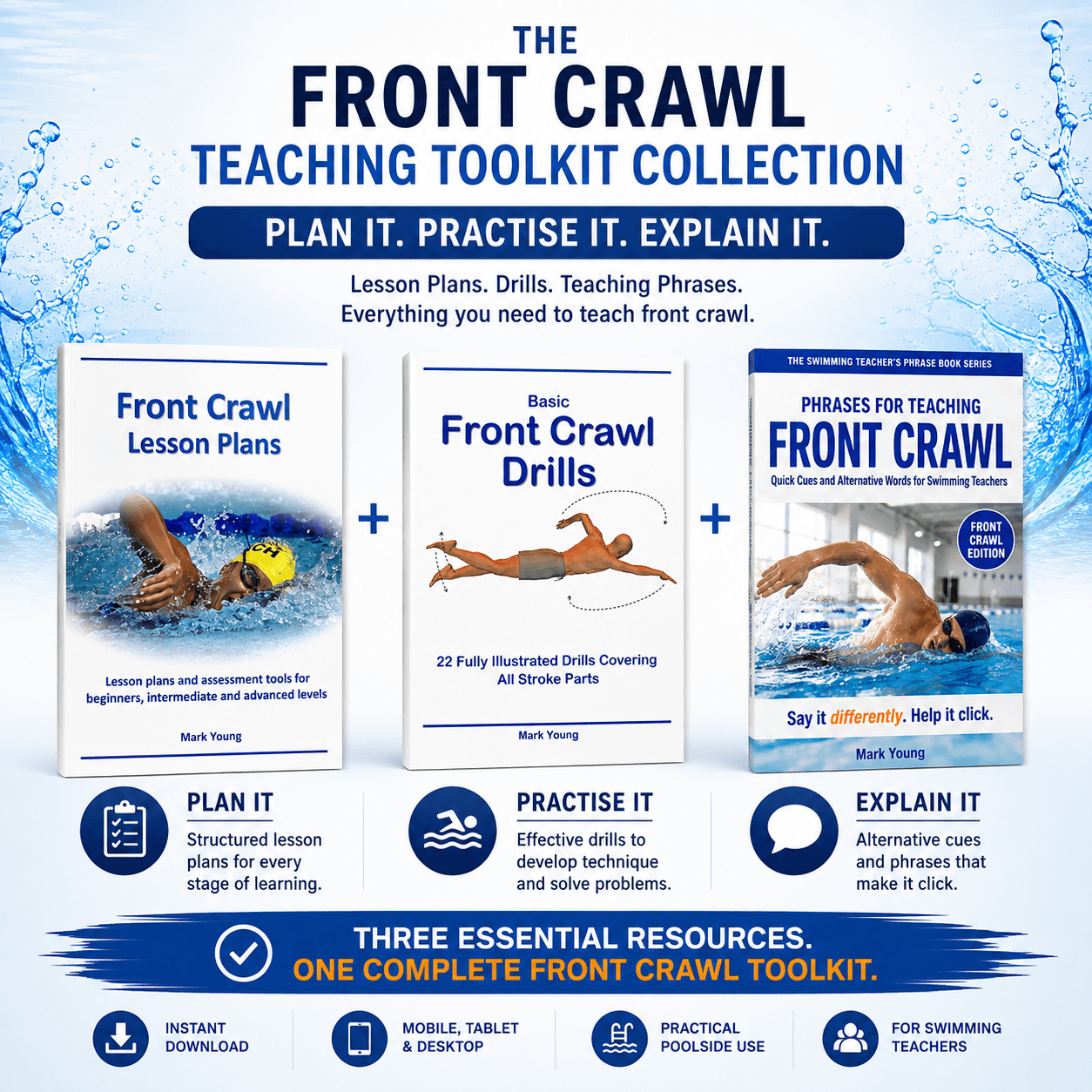
These are just a handful. When a swimmer still isn't getting it, the Front Crawl Teaching Toolkit has plenty more ways to say it.
When Breathing Still Isn't Clicking
Sometimes you need another drill to try, or another way of saying it. The Front Crawl Teaching Toolkit brings together my front crawl lesson plans, drills and teaching phrases, so you've always got something new to reach for when a swimmer gets stuck.

 |
Thanks for checking out my website and all the information here about learning to swim and teaching swimming. I really hope you have found some inspiration and support. If you're as passionate about teaching swimming and learning to swim as I am, feel free to follow me on any of these channels: Cheers!  |
Thanks for checking out my website and all the information here about learning to swim and teaching swimming. I really hope you have found some inspiration and support.
If you're as passionate about teaching swimming and learning to swim as I am, feel free to follow me on any of these channels:
Cheers!
All Rights Reserved