

- Swim Teach Home
- history of swimming
The History of Swimming
What is known about the history of swimming? Well, early cave paintings suggest that swimming is something that has been practiced since the Stone Age.
 The Cave of Swimmers circa 8000 years ago. Courtesy of Bradshaw Foundation
The history of swimming shows that swimming strokes have evolved since the 19th century.
The overarm sidestroke evolved from the sidestroke, where one arm was recovered above the water for increased speed and the legs were squeezed together in a rather uncoordinated action.
Early Swimming Strokes
John Trudgen developed a style that used a hand-over-hand arm action, and was then named the Trudgen. It was introduced in England in 1873 after he copied the stroke from one he saw in South America.
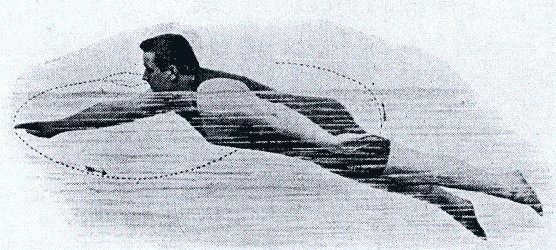
Each arm recovered out of the water as the body rolled from side to side and the swimmer performed a scissors kick with every two arm strokes. Over time this stroke developed into front crawl where variations of leg kick included different multiples of scissors kicks and also flutter kicks.
Over the years science has played its part in the history of swimming where competitive swimmers look for adjustments in their technique in order to gain advantages in speed and efficiency.
The inefficiency of the trudgen kick led Australian Richard Cavill to try new methods. He used a combined of an up-and-down kick with an alternating overarm stroke. This stroke became known as the Australian crawl and indicative of the modern day front crawl.
The history of swimming breaststroke and butterfly
Until the 1950s, the breaststroke was the only stroke with a required style. and it is suggested that the leg action may have originated by imitating the swimming action of frogs.
The underwater recovery of both arms and legs in the breaststroke created a large frontal resistance making it the slowest of the four basic swimming strokes.
In 1538, Nicolas Wynman, wrote the first swimming book, with his goal being to reduce the dangers of drowning. In doing so, his book contained a good, methodical approach to learning breaststroke.
Click here for a detailed breakdown of modern breaststroke technique.
In 1934 David Armbruster devised a double overarm recovery out of the water. This butterfly arm action gave more speed but required greater overall body strength and power.
Then in 1935, Jack Sieg developed a style of swimming on his side, kicking his legs in unison like a fish tail. This then developed further to a face down leg action. Armbruster and Sieg combined the butterfly arm action with this leg action and learned to coordinate the two with two kicks to each butterfly arm action. This kick was named the dolphin fishtail kick.
Even though the butterfly breaststroke, as it was called, was faster than the breaststroke, the dolphin fishtail kick was declared a violation of competitive rules.
For the next 20 years, champion breaststrokers used an out-of-water arm recovery (butterfly) with a shortened breaststroke kick. In the late 1950s, the butterfly stroke with the dolphin kick was made legal for competition.
Click here for a detailed breakdown of modern butterfly swimming technique.
Many swimmers say the "wiggle" is the key to the stroke and that a swimmer who can undulate through the water naturally can more easily learn the butterfly. (Source - The Washington Post)
Which swimming stroke do you need help with?



Click on a swimming stroke for more details.
Modern day swimming strokes made simple
The Swimming Strokes Book is a simple, easy-to-follow and practical book. Presented with clear diagrams and professional coaching tips, that make learning and improving swimming technique easy for beginners through to swimmers of every level. Download 82 easy drills that teach you what each part of your body should be doing. Complete with simple diagrams and detailed explanations.
Download a copy to your computer, tablet or mobile device by clicking below, or click here for more information.

$16.99

I am a member of the Amazon Associates Program and I will earn a commission from qualifying purchases at no extra cost to you.
|
Buy a PRINTED copy from: |
 |
You can also download from:


"Hello, I'm Mark Young, creator of Swim Teach.

I've been teaching swimming for over 30 years and I built this site so that I can share all my knowledge, wisdom and experience from the thousands of swimming lessons I have had the pleasure of teaching.
So if you're a fellow teacher, beginner swimmer or an improver, there is something here for you. Simply click around and scroll about, or get in touch and ask me a question."
Recent Articles


-
Can Adults Learn To Swim? Reasons You Never Thought Of Why They Can
Mar 09, 24 12:06 PM
Overcome the barriers and pain points and find the answer to the age old question 'can adults learn to swim?' Of course they can, and here is why. -
Swimming Guide For Beginners PDF - Everything You Need in One PDF file
Feb 23, 24 11:26 AM
Instantly download my easy to follow swimming guide for beginners pdf. Discover how to relax, float, and swim using this swimming for beginners pdf. -
Swimming In The Deep End - Venturing Into The Unknown For Beginners
Feb 22, 24 06:50 AM
Swimming in the deep end of the pool is not as scary as you think. Take it one step at time and overcome your fears.
NEED SOME SWIMMING HELP?
Get over to Facebook and join the Swim Teach group where swimming teachers help beginners learn how to swim.
Come on over, upload your videos of you swimming and get some tips and advice.