- Swim Teach Home
- lesson plans
- 30 Minute Swim Lesson Plan
- Teaching Swimming in a Crowded Pool
Teaching Swimming in a Crowded Pool (and a Mixed-Ability Class)
By Mark Young
Half a width of pool. Another class on one side, a public swim on the other, and aqua aerobics music bouncing off the walls. Eight swimmers in front of you, and no two of them at quite the same level. Sound familiar?
You’re not alone. Most of us don’t get to teach in a quiet, empty pool. We teach in the space we’re given, at the time we’re given it, with whoever turns up. I’ve taught plenty of lessons where the hardest part wasn’t the swimming, it was finding somewhere to put everyone.
The good news is that a crowded pool doesn’t have to mean a poor lesson. It just needs a different kind of plan. Below is how I keep swimmers safe, busy and progressing when space is tight, how I teach a mixed-ability group at the same time, and a 30-minute lesson plan built for exactly that.
Safety first, especially when space is tight
A busy pool changes the risks, so before you think about teaching points, think about where everyone is.
Count heads often. At the start, after every practice and before they get out. It takes five seconds and it becomes a habit.
Stand where you can see everyone. Nobody should be behind you. In a corner, that usually means standing on the corner and teaching outwards.
Keep distances short. Widths, half widths or across to a lane rope. Shorter distances mean swimmers are never far from the side, or from you.
Be careful with jumping and diving. If the water in front of you isn’t clear and deep enough, don’t do it. Save it for another lesson.
Speak up if it isn’t safe. If you can’t teach your group safely in the space you’ve been given, tell the pool staff. That’s not being awkward; it’s your job.
Make the space work for you
You can’t make the pool bigger, but you can use it more cleverly.
Swim widths, not lengths. Most teaching happens across the pool anyway, and widths keep your group together.
Use the corner. Two walls give you twice the “side” to work from: one for practising, one for waiting.
Treat a lane rope as a wall. Swimmers can hold it, push off it and swim to it. Just check it’s secure first.
Mark your area. A couple of floats at the edge of your space shows swimmers, and other teachers, where your class ends.
Agree the space with other teachers. A quick word before the lesson (“I’ll keep to the corner if you take the steps end”) saves a lot of bumping into each other later.
Organisation that works in a small space
How you organise the group matters more in a crowded pool than in an empty one. These are the patterns I use most.
All together, on the wall. Everyone holds the side and practises at the same time: kicking, bubbles, arm actions. It’s the best way to keep a big group busy in a small space.
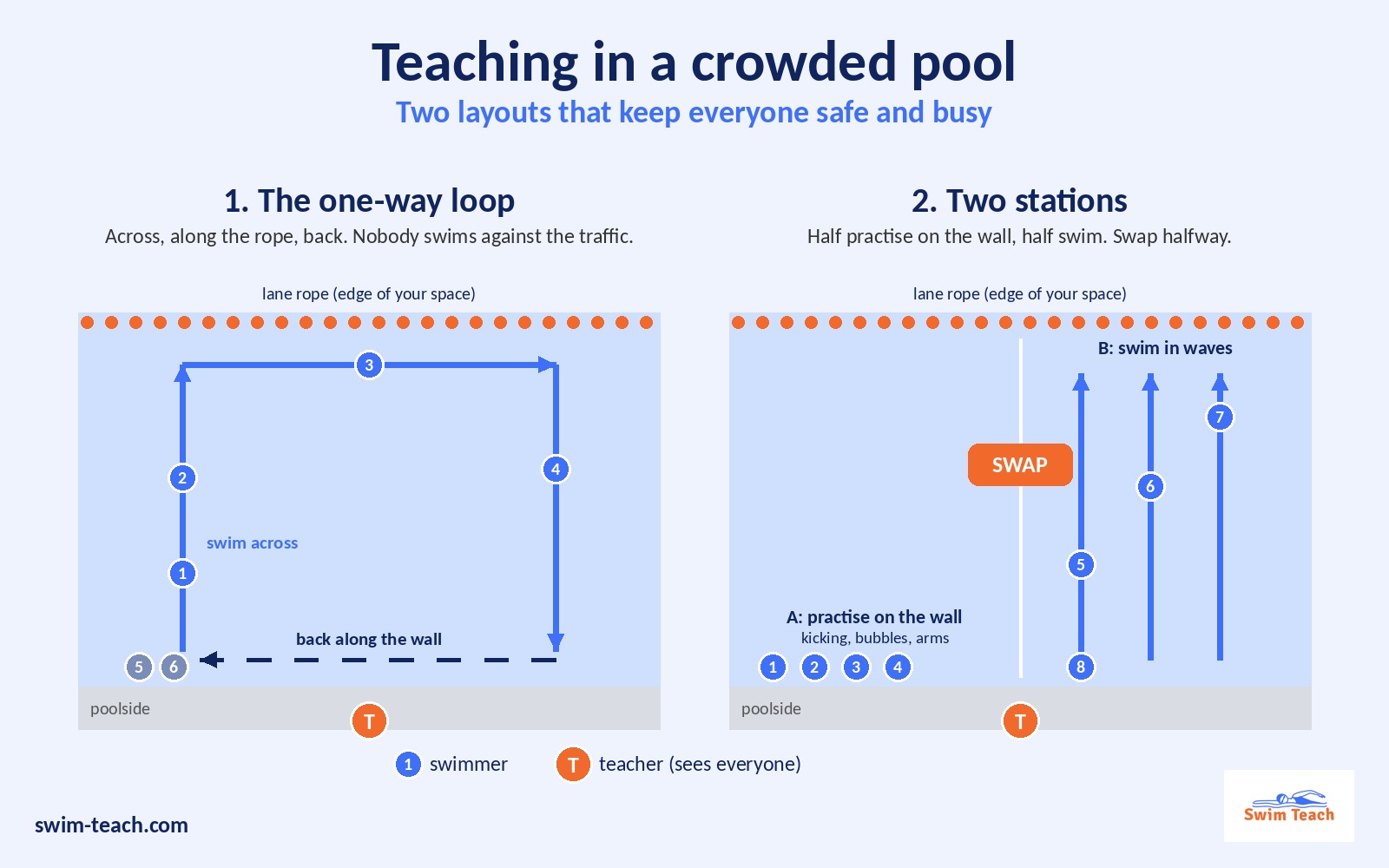
Waves. Two or three swimmers go at a time, and the next wave sets off when the first is halfway. You can watch each swimmer properly, and nobody waits long.
The one-way loop. Swimmers go across the width, then come back along the wall, never against the traffic. No collisions, and it keeps moving like a conveyor belt.
Two stations. Half the group practises on the wall while the other half swims, then they swap. It works brilliantly for mixed ability, because each half can be doing something different.

Keeping everyone busy (and stopping the queue)
Nothing kills a lesson like a queue. A swimmer standing still for two minutes gets cold, bored and, with children, usually a bit splashy.
My rule is no more than three swimmers waiting at any time. If there are more, I either send another wave or give the waiting swimmers something to do on the wall: kicking, bubbles, or practising the arm action while they wait.
Waiting time can be useful too. Ask the swimmers on the wall to watch the wave in front and tell you one thing they did well. They’re learning, they’re watching the right thing, and they’re not splashing.
Teaching a mixed-ability class
Almost every class is mixed ability, whatever the timetable says. The trick is not to teach to the middle, because the stronger swimmers get bored and the weaker ones get lost.
Instead, set the same task and change how hard it is. There are three easy ways to do that:
Change the equipment. A float or noodle for those who need it, none for those who don’t.
Change the distance. Half a width for some, a full width for others.
Add a challenge. Same practice, plus a breath to the side, or five kicks with the face in before breathing.
Everyone works on the same skill, so you only explain it once, but each swimmer works at the right level. Use waves to group swimmers of a similar level together, so the faster ones aren’t swimming over the slower ones.
A crowded pool lesson plan
Here’s Plan #27 from my book 101 Swimming Lesson Plans, a first go at full stroke front crawl for beginners. The practices and teaching points are the same as in the book. What’s changed is the organisation, so it works in about half a width of a busy pool, with easier and harder versions for a mixed group.
I’ve also swapped the jumping and sitting dive at the end for activities that stay in your own space. In a crowded pool, the water in front of the side is rarely clear enough.
| Activity | Teaching point | Crowded pool organisation | Time |
|---|---|---|---|
| Entry: swivel or steps entry | enter slowly | one by one | 1 min |
| Warm up: kicking, holding the poolside Easier: noodle under the arms. Harder: face in, blowing bubbles. | kick from your hips | all together, on the wall | 3 mins |
| Main theme: push and glide, holding a float if needed | stretch out and glide | waves of 3, one-way loop | 2 mins |
| Kicking while holding a float under each arm Harder: one float held out in front. | kick with floppy feet | waves of 3, one-way loop | 2 mins |
| Single arm pull with a float held under one arm, then the other arm Easier: standing practice on the wall first. | elbow leads out first | two stations, then swap | 4 mins |
| Holding a float with a diagonal grip, turning the head to breathe, then the other side Easier: practise the head turn holding the wall. | turn your head to the bent elbow | two stations, then swap | 4 mins |
| Alternate arm pulls holding a float out in front | count 1, 2, 3 each pull | waves of 3, one-way loop | 3 mins |
| Full stroke front crawl Easier: half width with a float. Harder: full width, breathing every three strokes. | continuous arm pulls and leg kicks | waves of 3, one-way loop | 3 mins |
| Contrasting activity: star float in your own space | deep breath and relax | 2 or 3 at a time | 3 mins |
| Treasure hunt: collect sinkers dropped in your own area | eyes open, deep breath | 2 or 3 at a time | 3 mins |
| Exit: pool steps or over the poolside | take your time | one by one | 1 min |
| Total | 29 mins |
Organisation key: “waves” means small groups taking turns. The “one-way loop” means swimming across and coming back along the wall. “Two stations” means half the group practises on the wall while the other half swims, then they swap.
When the pool is just too busy
Some days the plan has to change the moment you walk out. A gala warm-up has spilled over, or your half width has become a quarter. That’s fine. The lesson doesn’t have to be the one you wrote.
Cut a practice, don’t rush them all. Two practices done well beat four done in a hurry.
Do more on the wall. Kicking, bubbles, arm actions, and breathing practice all work without anyone going anywhere.
Teach from the poolside. A good demonstration and a short cue go a long way. In a noisy pool, short cues matter even more. My free poolside cue cards give you two ways to say every part of every stroke.
Make a note. If a skill got squeezed out, jot it on your progress tracking sheet and pick it up next week.
Lesson plans you can adapt to any space
Every plan in my 101 Swimming Lesson Plans is built on the same simple shape as the one above, with an organisation column for every practice, so you can see at a glance how to run it with waves, on the wall or all together. Swap the organisation to suit your space, and the lesson still works. For more ideas, see all my swimming lesson plans in one place.

Need Fresh Lesson Ideas For Your Swimming Classes?
Here are 101 ready-made swimming lesson plans designed to help you walk onto the poolside with a clearer plan, more confidence, and less last-minute preparation.
- 101 complete lesson plans ready to use
- Covers different swimmer levels and abilities
- Instant PDF download for mobile, tablet, or desktop
Crowded pool and mixed-ability lessons: common questions
How many swimmers should one teacher have?
There’s no single answer. It depends on the swimmers’ age and ability, the water depth, and your pool’s or swim school’s own rules. Check their ratios, and if a group feels too big to keep safe, say so.
Should I teach widths or lengths in a busy pool?
Widths, almost always. They keep the group together, keep swimmers close to the side and make it far easier to see everyone.
How do I stop swimmers queuing?
Use waves and set off the next wave before the last one finishes. Give anyone waiting a task on the wall. No more than three swimmers should be standing still at once.
How do I teach two levels at the same time?
Give everyone the same skill and change how hard it is: a float or no float, half a width or a full one, or an added breathing challenge. Group similar swimmers in the same wave.
What if another class keeps drifting into my space?
Mark your area with a couple of floats and have a quick, friendly word with the other teacher before the next lesson. If it keeps happening, mention it to the pool manager.
For your next crowded lesson, try just one change: a one-way loop. Swimmers go across the width and come back along the wall, and nobody swims against the traffic. You’ll be surprised how much calmer the lesson feels, and how much more swimming everyone gets done.
A busy pool is just part of the job. Plan for it, keep it simple, and your swimmers will still go home a little better than they arrived.

 |
Thanks for checking out my website and all the information here about learning to swim and teaching swimming. I really hope you have found some inspiration and support. If you're as passionate about teaching swimming and learning to swim as I am, feel free to follow me on any of these channels: Cheers!  |
Thanks for checking out my website and all the information here about learning to swim and teaching swimming. I really hope you have found some inspiration and support.
If you're as passionate about teaching swimming and learning to swim as I am, feel free to follow me on any of these channels:
Cheers!
All Rights Reserved